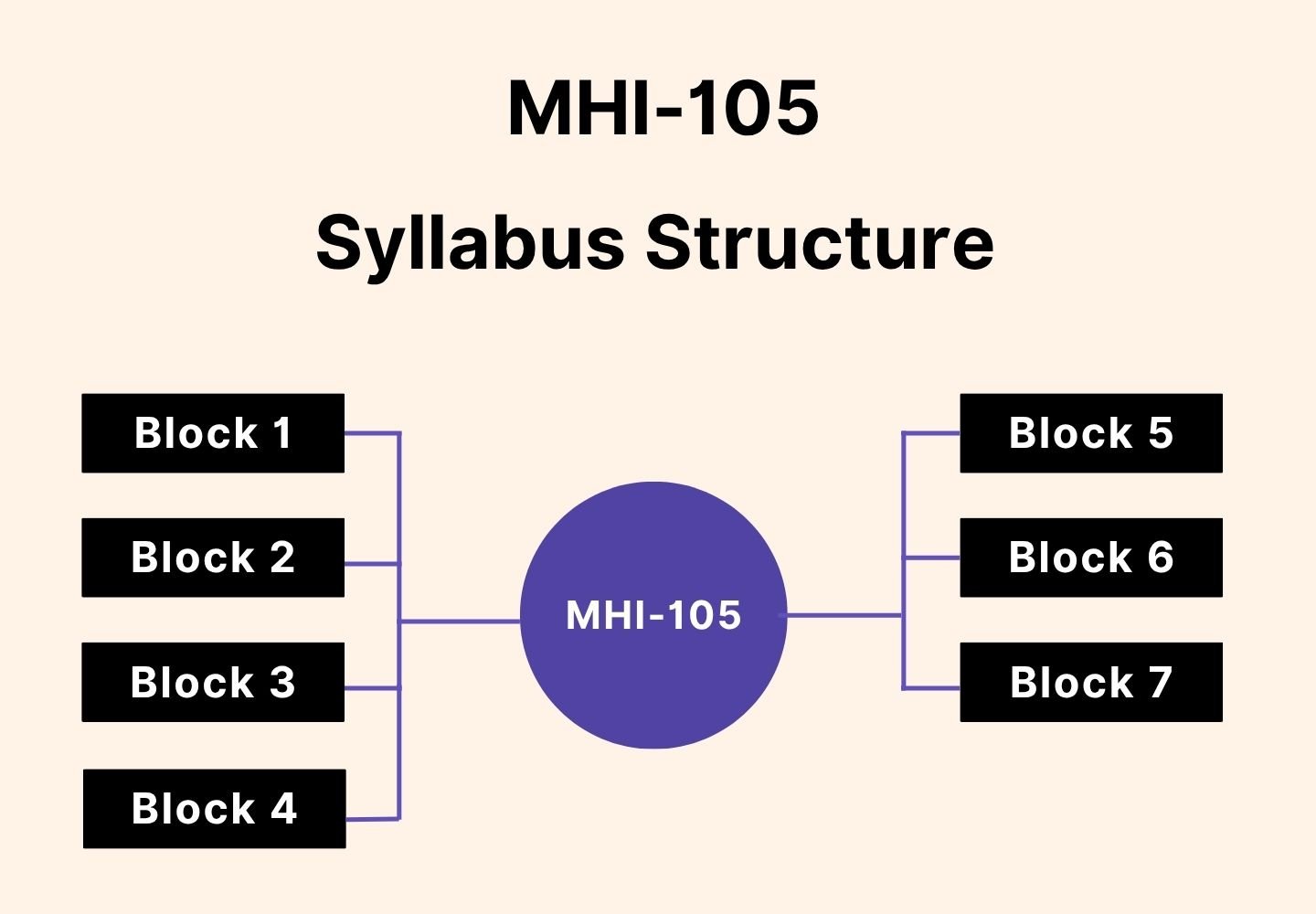
MHI-105 Syllabus | History of Indian Economy-1 : From the Earliest Times to c. 1700 Last Updated on April 14, 2026 Table of Contents Here you will get the full syllabus for the IGNOU MHI-105 : History of Indian Economy-1: From the Earliest Times to c. 1700. The syllabus of IGNOU MHI-105 is divided in 7 Block and each block is again divided in Section. We have listed the detailed syllabus of all the 7 Block and its Unit. We have also provided a Link to the Download Full Syllabus PDF of MHI-105. IGNOU MHI 105 Syllabus Structure Content Syllabus of MHI-105 Course Code MHI-105 Course Title History of Indian Economy-1: From the Earliest Times to c. 1700 Course Type Compulsory Course BLOCK Total 7 Block Programme MAH : Master of Arts in History University IGNOU ( Indira Gandhi National Open University ) IGNOU MHI 1st Year Most Repeated Questions eBook Rated 4.71 out of 5 ₹299.00 – ₹399.00Price range: ₹299.00 through ₹399.00 Get MHI Repeated Questions Block 1 – Historiography, Environment and Economy Unit 1 – Economic Historiography of Early India Unit 2 – Historiography of the Medieval Economy Unit 3 – Environmental Zones and Indian Economic History IGNOU MHI 1st Year Most Repeated Questions eBook Rated 4.71 out of 5 ₹299.00 – ₹399.00Price range: ₹299.00 through ₹399.00 Get MHI Repeated Questions Block 2 – Emergence of Early Economic Structures Unit 1 – Origins of Agriculture, Animal Domestication, Craft Production to Urbanisation (Case of the Harappan Civilisation) Unit 2 – Archaeology and Geography of Agricultural and Pastoral Communities of the Subcontinent to the Middle of the First Millennium BCE IGNOU MHI 1st Year Most Repeated Questions eBook Rated 4.71 out of 5 ₹299.00 – ₹399.00Price range: ₹299.00 through ₹399.00 Get MHI Repeated Questions Block 3 – Complex Economic Structures Unit 1 – Comparative Structures of Economies in Some Early States: Maurya and Kushana Unit 2 – Comparative Structures of Economies in Some Early States: Satavahana and Gupta Unit 3 – Patterns of Trade, Urbanisation and Linkages: North India (c. 600 BCE-300 CE ) Unit 4 – Patterns of Trade, Urbanisation and Linkages: Peninsular India (c. 300 BCE-300 CE) Block 4 – Early Medieval Economy and its Continuities Unit 1 – The Indian Feudalism Debate Unit 2 – Organisation of Agricultural and Crafts Production: North India, c. 550-1300 CE Unit 3 – Regional Profiles of Agrarian Society and Nature of Stratification: North India, c. 550-1300 CE Unit 4 – Organisation of Agricultural and Crafts Production, Regional Profiles of Agrarian Society, Nature of Stratification: South India Unit 5 – Exchange Networks, Guilds, Merchant Lineages, Items of Trade and Commercial Tax, Urbanisation: North India, c. 300-1300 CE Unit 6 – Exchange Networks, Guilds and Merchant Lineages, Items of Trade and Commercial Tax, Urbanisation: South India Block 5 – Medieval Economy: c. 1300-1700 Unit 1 – Agricultural Production Unit 2 – Agrarian Relations: North India Unit 3 – Agrarian Relations: Deccan and South India Unit 4 – Non-Agricultural Production and Organisation of Craft Production Unit 5 – Fiscal System: North India Unit 6 – Fiscal System: Deccan and South India Block 6 – Trade, Technology, And Urbanisation: c. 1300-1700 Unit 1 – Inland and Maritime Trade Unit 2 – Business Practices and Monetary History Unit 3 – Technology and Economy Unit 4 – Transport and Communication Unit 5 – Urban Centres in Medieval India IGNOU MHI 1st Year Most Repeated Questions eBook Rated 4.71 out of 5 ₹299.00 – ₹399.00Price range: ₹299.00 through ₹399.00 Get MHI Repeated Questions Block 7 – Women and Economy Unit 1 – Women and Work Upto c. 1300 CE Unit 2 – Women and Work: c. 1300-1700 CE IGNOU MHI 1st Year Most Repeated Questions eBook Rated 4.71 out of 5 ₹299.00 – ₹399.00Price range: ₹299.00 through ₹399.00 Get MHI Repeated Questions MHI Related Posts Click On Any Year ⬇️ 1st Year MHI 101 SyllabusMHI 101 Question Papers MHI 102 SyllabusMHI 102 Question Papers MHI 104 SyllabusMHI 104 Question Papers MHI 105 SyllabusMHI 105 Question Papers 2nd Year MHI 103 SyllabusMHI 103 Question Papers MHI 106 SyllabusMHI 106 Question Papers MHI 107 SyllabusMHI 107 Question Papers MHI 108 SyllabusMHI 108 Question Papers MHI 109 SyllabusMHI 109 Question Papers MHI 110 SyllabusMHI 110 Question Papers MHI 111 SyllabusMHI 111 Question Papers

 1st Year